




|
Last Updated:
Feb. 8, 2002
|
|
The Surgery ... (Season 2001)
The 2001 season was a disappointing and flustrating season for Hentgen. It ended much too soon, officially
on May 25th, 2001 when Pat was placed on the 15 day disabled list retroactive to May 17th. Tendinitis
in his right elbow was causing Pat major discomfort while pitching.
While he could throw his fastball, cutter and change-up, throwing a curveball was causing him some pain in
his elbow. This elbow pain forced Pat to miss his scheduled start against the Twins.
Pat last pitched on May 16 against the Detroit Tigers, leaving him 2-3 with a 3.47 ERA on the 2001 season. |
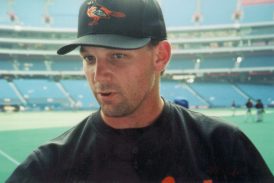
Pat in Toronto during his first trip
back as an Oriole.
Sign the Guestbook ... & say get well to Pat!
Or you can just have a look ...
|
In the days that followed Pat went for an MRI. Orthopedic specialist, Dr. James Andrews examined Pat and
concluded that he has a sprained elbow ligament which would require a more lengthy
rest than originally predicted. Initially Pat would try to rehabilitate the arm via various exercises and
strength
conditioning programs.
"To be honest, I didn't think I'd miss a start when I felt pain against the Tigers, and it just
hasn't gotten better at the rate that I had hoped it would, I feel a significant pinch, which I think
is probably a good thing because we can narrow it down to what it is. I think it's just tendinitis"
-- Orioles pitcher Pat Hentgen
|
At the end of July it looked as though the last obsticle in Pat's way to a rehab start was a few pitches
in a simulated game before the O's regular game on Sunday. Hentgen tossed for about 12 minutes on flat
ground before attempting to throw off the mound. However Pat only managed to throw seven pitches before
having to shut it down, feeling pain similar to what sidelined him in the first place. With this development
Pat made another visit to Birmingham, Alabama to see orthopedic Dr. James Andrews. This time the news wasn't
as good and surgery was the best option. On August 9th, while the Orioles were in Kansas City to play the
Royals, in Birmingham Alabama, orthopedic surgeon Dr. James Andrews perfomed ulnar collateral ligament
replacement ("Tommy John") surgery on Pat. Hentgen is likely to miss the entire 2002 season.
Many other players have undergone the procedure, including John Smoltz, Kerry Wood, David Wells, Jim Gott,
Billy Koch, Tom Candiotti, Norm Charlton and position players, Paul Molitor and Jose Canseco to name a few.
While missing an entire season may seem devastating, the same injury 26 years ago would have ended his
pitching career.
|
|
|
|
|
"I haven't been the greatest pitcher, but I've been durable and I've always taken pride in that,
Durability is one thing I usually can bring to a team and I just wasn't able to do it, and that's
been the most disappointing thing. I go out there and try to compete and give my team a chance to
win. To not be able to do that has been bothersome."
-- Orioles pitcher Pat Hentgen.
"When I was considering surgery, I learned that the numbers were on my side, that I had at least an
80%-85% chance of returning. I knew my choice was to either have the surgery or retire"
-- Orioles pitcher Pat Hentgen.
"Everything went fine. From what we understand, it was successful, Dr. Andrews was very pleased with
what he found in there and his ability to be able to repair it."
-- Orioles manager Mike Hargrove on Hentgen's surgery.
|
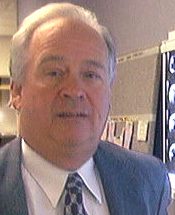
Dr. James R. Andrews
|
The Operation ... (what they did)
Pat underwent 'ulnar collateral ligament replacement' or 'Tommy John' surgery. The procedure was created by
the pioneering surgeon, Dr. Frank Jobe in 1974 as a way of extending the pitching career of injured pitcher,
Tommy John.
Pat's surgery was performed by Dr. James R. Andrews, an internationally renowned orthopaedic surgeon and
one of the founding members of the Alabama Sports Medicine & Orthopaedic Center (ASMOC) and the American
Sports Medicine Institute (ASMI). He is well-known for his scientific and clinical research contributions
on knee, shoulder and elbow injuries, as well as his refined skill as an orthopaedic surgeon.
Dr. Andrew's is one of the leading authorities in this area and his opinion is highly sought after.
|
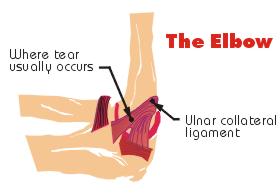
The idea behind the surgery is to re-build the ligament in the pitchers' elbow by replacing it with a tendon
from his forearm.
The repetitive motion of pitching can be very hard on the elbow. The pitcher relies
on the ulnar collateral ligament to stabilize the inside of their elbow through the pitching motion.
A pitcher with this injury will typically complain of pain in the elbow while delivering his pitch, along
with a loss of velocity and control. As in Pat's case, throwing the curve ball was causing him pain, while
his usually good location and control wasn't always there.
|
|
|
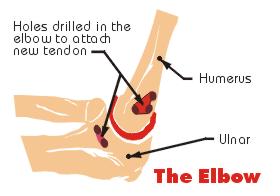
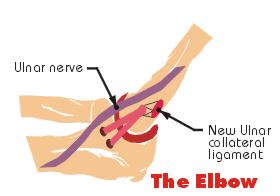
The concept of the procedure is somewhat 'simple'. The surgeon first must drill a pair of holes in the
bones of the elbow to attach the new tendon to. One hole is drilled in the Humerus and the other hole is
made in the Ulnar. These holes will serve to anchor each end of the new tendon.
Typically a tendon from the forearm (the palmaris longus tendon) is the removed and used to create a
new ulnar collateral ligament on the inside portion of the elbow. However, not everyone has this particular
tendon and Pat fell into that group. Instead Dr. Andrews took the autogenous gracilis tendon from just
below Pat's left knee to use.
|
Sometimes the ulnar nerve which can interfere with the location of the newly created ulnar
collateral ligamnet is moved forward to a new location. In this case Andrews also had to move
Hentgen's ulnar nerve.
Many say that the surgery results in a elbow that is better and stronger. The key however to sucessful
surgery appears to be the rehab and not rushing back too soon.
|
|
The Rehab & Recovery ...
The rehabilitation process is critical if the surgery is to allow Pat to return to his place on the pitcher's
mound. Shortly after his operation Pat started attending physical therapy sessions three times a week at
Henry Ford Rehabilitation in his hometown of suburban Detroit. While there, Therapist Brian Macks puts
Hentgen through a roughly 90 minute workout consisting of about a dozen exercises designed to increase
Pat's arm strength, flexibility and regain his range of motion.
While Pat's arm remained in a sling and a half cast for the first four weeks, the pain vanished far quicker.
Even before the swelling subsided in his elbow, Hentgen's first exercise was to squeeze a small soft rubber
ball. After six weeks Pat was able to straighten out his arm. Over the next few weeks Hentgen progressed
through a series of stretching exercises to a series of low weight forearm exercises.
"When Pat showed up here, he was in great shape thanks to his pre-surgery routine. Our goal
was to make sure his whole upper quadrant was functioning well. You have to take care of the joints above
and below the elbow to have a successful outcome. We work at an advanced level of therapy and we're
constantly looking for new goals to attain, so it doesn't get too monotonous."
-- Pat's Therapist Brian Macks
|
"The surprising thing to me was they also had me doing a lot of shoulder exercises too. They say the
shoulder and elbow area really feed off each other. The mission was an overall strengthening.
It's amazing how little muscles in your body are so weak and you don't know it."
-- Orioles pitcher Pat Hentgen
|
Pat's road to recovery started out slowly. At the start Hentgen would just push his arm against the wall for
a few minutes at a time. The Pat added some light weights to his routine. Initially Pat used 1 and 2 pound
weighs for wrist curls and extensions, but after a couple of months Hentgen had progressed to 10 and 15 pound
weights. By October, Pat's routine included a little catch along with throwing a weighted ball against a
trampoline type device called a 'plyoback', similar to some throwing the ball against the wall.
Along with these workouts designed to regain Pat's strength and range of motion, Brian Macks used a few other
rehab techniques from his bag of tricks. Vibrations created via Ultrasound were used to stimulate blood flow
to the muscles and tendons, while electrostimulation was used to contract muscles in order to maintain the
existing muscle strength.
"I feel like I have my strength back, my range of motion is back. I guess the best thing about it is
I feel like this (surgery) never even happened."
-- Orioles pitcher Pat Hentgen
|
Hentgen has regained his full range of motion, but he is still a bit away from taking the mound and mowing
down a few batters. While Pat was anxious to begin working out with a baseball in early Decemeber, the O's
felt Hentgen should wait until spring training. Pat is reporting to spring training along with the other
Orioles pitchers to continue his workouts and rehab, while adding working out with the baseball to his
other routines.
An excerpt from Baseball Weekly ...
I know exactly when it happened," said Hentgen, recalling the initial twinge in his elbow. "It was May
16 against the Tigers in the first inning — the first curveball I threw. I didn't do anything
differently, but I remember coming in after that inning thinking: 'I just hurt my elbow.'
"I've thought about it over and over. Did I warm up differently? I know I didn't. Even though I had the
discomfort, I was able to pitch seven innings (and win) that day. I wanted to make my next start, but when
I went to throw on the side my elbow was just too sore. I had to push that next start back. After 10 days
I thought it might be safe to throw — maybe the elbow would be better — but it wasn't."
|
Check out the entire article,
along with other great stories
at the
Baseball Weekly website
|
Like so many of his peers, Hentgen made the trip to Birmingham, Ala., to see Andrews, an orthopedic surgeon
at HealthSouth Medical Center. There he had a saline-enhanced MRI exam. The exam revealed that Hentgen
had a tear of the ulnar collateral ligament, but he was not a clear-cut candidate for immediate surgery.
"He told me to try to rehab it," Hentgen said. "Pitchers can go another three or five or eight years in a
situation like mine."
Surgery was an option — but the last option. By rehabbing, Hentgen learned that his arm would be that much
stronger going into any operation. He remained with the Orioles, traveling with the team, working with
trainers Rich Bancells and Brian Ebel, home and away.
"I did everything with the team except take the ball every fifth day," he said. "I spent eight weeks
rehabbing. For three weeks I didn't pick up a ball. I have to credit Rich and Brian for all the time they
put in, showing me the proper manual resistance exercises and keeping me mentally on the right track.
"When I started my long throwing, I thought there was a chance I'd be back. The whole time I was throwing
on flat ground I felt really good. Eventually, I thought it was time to put up or shut up. But as soon as
I got on the mound I couldn't put anything on the ball."
It was the last week of July and the Orioles were in Anaheim when Hentgen realized he still was in trouble.
Lewis Yocum, the Angels' team doctor and an orthopedic surgeon, was in the clubhouse checking on pitcher
Willis Roberts. Hentgen asked him for an evaluation.
"He looked at my X-rays and thought it looked pretty grim," Hentgen said. "I could have waited another nine
weeks or nine years. It wouldn't have mattered."
It was time for a second trip to Birmingham. Hentgen knew in his heart that the time had come for surgery.
Hentgen had confidence in Andrews. He'd first seen him about his elbow in 1992 when tests determined he had
no tear. Not only was he pitching in '93 (going 19-9 in his first full season in the majors), he became a
beacon of durability, making 183 consecutive starts before a bout with shoulder tendinitis in 1998. Before
his current stint, Hentgen never had been on a major league disabled list.
"In this situation you have to trust somebody," Hentgen said. "You have to ask yourself: Do you want to
continue to play or do you want to go play golf and feel zingers in your arm every time you hit your
wedge? I was a little nervous, but I knew Dr. Andrews' numbers were great. He'd done this surgery a lot of
times."
Hentgen's operation Aug. 9 was fairly routine — not much different from thousands of other Tommy John
procedures Andrews had performed. Hentgen had no palmaris longus tendon, so Andrews opted to take the
autogenous gracilis tendon, removing it from a 3-centimeter incision just below Hentgen's left knee.
Andrews also had to move Hentgen's ulnar nerve.
"They wheeled me into surgery around 3 p.m. I woke up around 7:30. The next morning I flew home to
Michigan," Hentgen said. "That first night is miserable. Any time you touch the integrity of the bone
it's going to hurt."
Hentgen's hope is to be pitching a year after surgery, but he knows not to push it. "The one thing I've
heard stressed is: Don't rush it, or you'll have a setback."
That might be the hardest part of all, particularly for Hentgen, who's signed to a two-year, $9.6 million
deal for 2001 and 2002 with a team option for 2003.
"I come here after hardly missing a start in nine years, then make only nine starts and my elbow blows
out. It makes me feel terrible," he said. "I'd like to pitch in August or September — at least be back
when rosters expand (Sept. 1). The Orioles have been great about it, but I'm going to be 34 next year,
coming off (surgery). I have to wonder: Are they going to want to pick up my option?"
|
|
|

 Send me Email





