Painting
Emptying Paint from Spray Cans
I've only used a spray can once, and never again. To me its like using a fire hose to water a potted plant!
I only empty what I need into a small bottle. I modify the nozzle by drilling it out with a 1/4" drill so I can push a small drinking straw into it. The kind of straw that you can bend at one end. I then put a lid with a hole for the straw and a small vent hole on the bottle. I tape it down so it won't come off during this process. I then spray through the straw, while holding the straw in place, and collect the paint in the bottle.
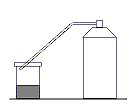
The spray can's propellant will cool the paint down so I put the bottle in a pan of hot tap water to warm the paint. This will also help the paint to 'gas out' the propellant. I also stir the paint to help it 'gas out'. Only then do I put the lid on the bottle or use it in my airbrush. If you don't do this, pressure from the propellant will build and the paint will spray when you open the bottle or squirt through the airbrush bottle vent hole.

Gloss White
Submitted by André Boucheré
When trying to paint gloss white on dark coloured styrene, undercoat with flat white or primer, this will give the gloss white a textured surface to adhere to so it won't run away from the edges.
Holding Parts
Submitted by André Boucheré
- Use toothpicks or cocktail sticks to mount parts prior to airbrushing, most parts have a small hole somewhere or you can use a small piece of tape mounted to the backside.
- Use plasticine to stick toothpicks in, provides a great place to store freshly painted parts, it's a great third hand.
Masking with Paper Towel
If you need to mask a highly complex surface that has fragile paints like
metallizers, then give this a try.
Apply wet paper towel to the part and push it down into all the nooks and crannies and then let dry. The paper towel will hold its shape and 'stick' to the part. Airbrush the part making sure to spray away from the edge of the paper towel so there is no way to blow paint under it. Remove paper towel. I tried this for the first time on the YZF-R1's engine since the cylinder head needed to be semi-gloss black and the engine case aluminium.
BTW, you can also use facial tissue but NOT toilet tissue. The latter is designed to 'dissolve' once wet.
Match 1:1 Colours
A lot of modellers get too caught up in finding the 'right' colour for their
models. Unless you see the 1:1 motorcycle in person you can only consider photographs as a
guide and not the the definitive answer. The photography and printing process greatly
affect the final colour on the printed page.
And don't forget lighting conditions. A colour changes under different light sources. A colour that looks perfect in natural sunlight will look different under incandescent and fluorescent lights.
So, paint your model with the colour that looks 'right' to you, but don't waste too much time and energy finding the perfect colour.
Mixing (1)
To get consistent ratios when mixing paint or thinning paint, I use eye droppers
for extracting paint and thinner from the bottles. The eye dropper draws a consistent
amount of paint or thinner and I have better success duplicating ratios time after time. I
prefer the eye dropper made of glass since they're easier to clean up.
Mixing (2)
Submitted by André Boucheré
When using paints, glues, solvents always remove some from their containers, this avoids
contamination of the rest of the material.
Mixing (3)
I found the ideal stirring sticks for mixing paint. Use plastic coffee and tea
stir sticks. Several hundred only cost a $1 or $2 and will last a long time.
Also, place two or three ball bearings in your bottles of paint. They act as agitators if shaking the bottle to do the initial stirring.
Multi-coloured Parts
Submitted by André Boucheré
When airbrushing a masked area, always spray away from the tape, this will prevent bleed under and result in a cleaner line.
Personal Health
Submitted by André Boucheré
- Invest in a proper respirator mask that protects you from "organic vapors", prolonged use with enamels, metallizers, SnJ polishing compounds, thinners and other solvents can have detrimental affects on your health. Long-term affects are not known, don't become a statistic for the cost of a couple of bucks!
- Use latex gloves to protect your hands from harsh paints and thinners. These also to prevent fingerprints on painted surfaces.
| << Previous |
Next >> |
Copyright © 2003, Kenneth W. Hartlen. All rights reserved
For more information visit www.interlog.com/~khartlen